How to Build and Deliver an Effective Toolbox Talk

Brady Keene
Co-founder, COO and Head of Safety
What a Toolbox Talk is and what it is not
A toolbox talk is a short crew briefing on a specific hazard, delivered before the work that exposes the crew to that hazard. It is not formal training and it is not a pre-task-plan. The PTP identifies and controls hazards at the task level. The talk briefs the crew on one hazard and confirms shared mental model. Treating the talk as a substitute for either is the most common program defect.
Step 1 - Topic selection
Weight topics in this order:
- High-energy hazards present in today's work. Gravity, motion, mechanical, electrical, pressure, temperature, chemical, radiation, sound, biological, and stored energy. If a high-energy hazard is on the schedule, it gets the talk.
- Recent site observations, near misses, and SIF precursors logged in the last seven days.
- Seasonal and regulatory drivers tied to current exposure (heat, cold, silica, trenching after thaw).
- OSHA top-cited standards relevant to the trade.
A talk on ladder safety on a day with no ladder work is theater. A talk on the warning line that got moved on the south deck yesterday is intelligence.
Step 2 - Structure
Five parts. Five to ten minutes total.
- Name the hazard and the energy source. Specific to today's work. Thirty seconds.
- Describe what failure looks like. Use a real example from your site or a CPWR Fatal Facts case if you do not have one. Site specific always beats generic. One to two minutes.
- Walk the controls in hierarchy order. Elimination, substitution, engineering, administrative, PPE. Tie each control to a specific action on the actual site today. Two to three minutes.
- Open the floor. Ask one direct question. Not "any questions" but "where on this site could this happen and we would not see it." One to two minutes. Capture what the crew says.
- Confirm and document. Sign in. Note any hazard, concern, or near miss raised during the talk. One minute.
Step 3 - Delivery
- Hold the talk where the work happens when possible. Point at the hazard.
- Talk to the crew, not at them. No reading from a sheet.
- One topic. Bundling kills retention.
- Plain language at a sixth grade reading level.
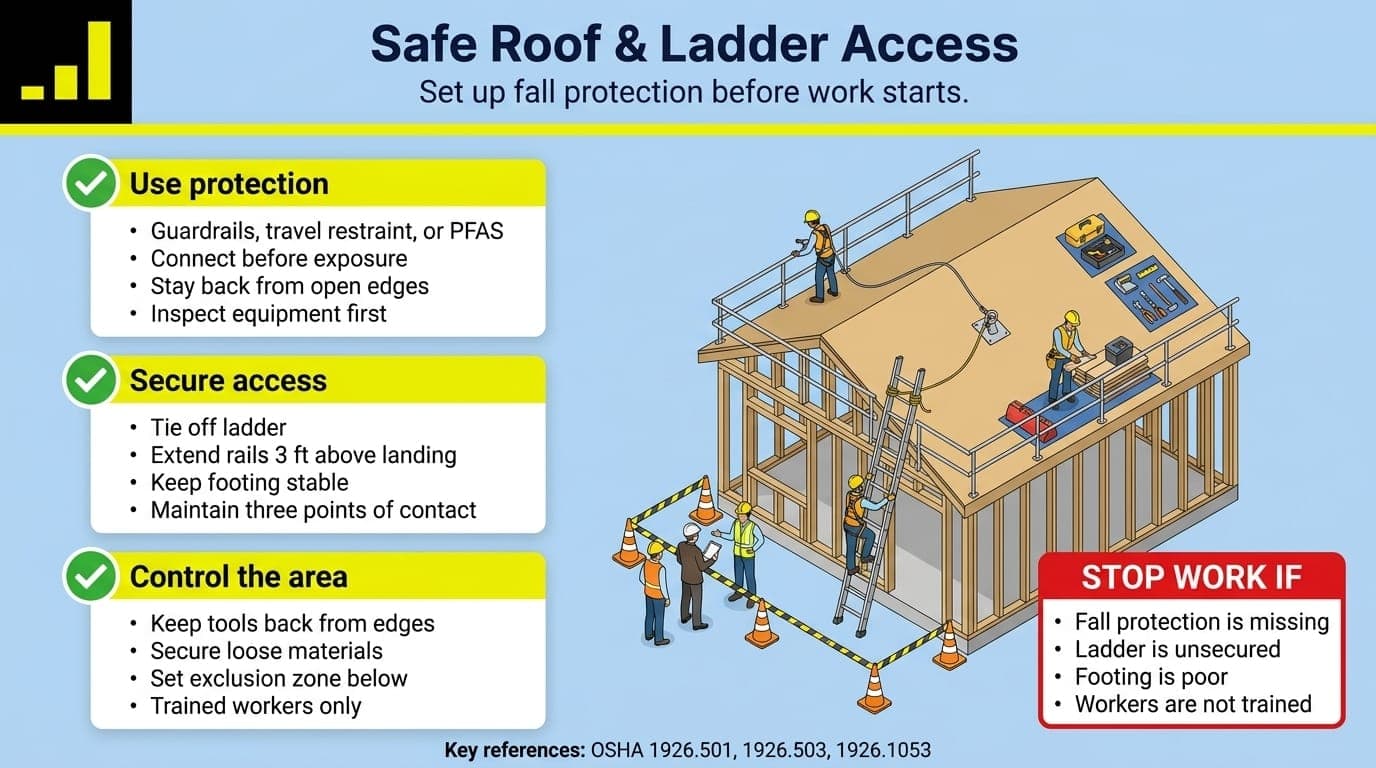
- Visual reinforcement. A photo of the actual hazard or actual equipment outperforms paragraphs.
- Multilingual reality. If your crew runs more than one language, the talk runs more than one language. CPWR publishes its full library in English and Spanish. For other languages, peer translators on the crew, not Google Translate.
- Rotate the presenter. Crew-led talks generate higher engagement than foreman-led talks for behavioral topics. Team leaders keeps the talk on regulatory and high-risk topics.
- Lead by example. The first time the team leader violates the rule he just covered, the program is over.
Step 4 - Documentation
Every talk needs:
- Date, location, and crew
- Topic and energy source
- Presenter
- Attendee signatures
- Notes on hazards, concerns, or near misses raised
- Closure tracking on anything raised that requires follow up
The notes field and the closure tracking are what convert a compliance ritual into a feedback loop. Most contractors skip both.
Step 5 - Measurement
A toolbox talk program is working when:
- Observation and near miss reporting rates trend up after the talk on a related hazard.
- Repeat topic frequency drops as crews internalize controls.
- Concerns raised in talks get logged and closed
- High-energy hazard topics make up the majority of the calendar over a quarter.
A program is failing when attendance is high, sign-in sheets are clean, and observation rates are flat. That pattern is the signature of attendance theater.
Regulatory anchor
OSHA does not require “toolbox talks” as a named program, but it does require hazard-specific instruction under 29 CFR 1926.21(b)(2) and under applicable topic-specific standards. A signed sheet with topic, date, presenter, and attendee signatures is what compliance officers ask for during inspections. Without it, the verbal training argument loses.
Related Posts
Continue reading with these related articles

Safety Observations: Quality or Quantity? The Argument Is About the Wrong Thing

What Is HECA, and What Do I Actually Do With It?

One Number, Two Jobs: What EMR Can and Cannot Do for a Construction Executive