What is the SCL Model? A plain language guide for safety teams

Brady Keene
Co-founder, COO and Head of Safety
Same event, different answers
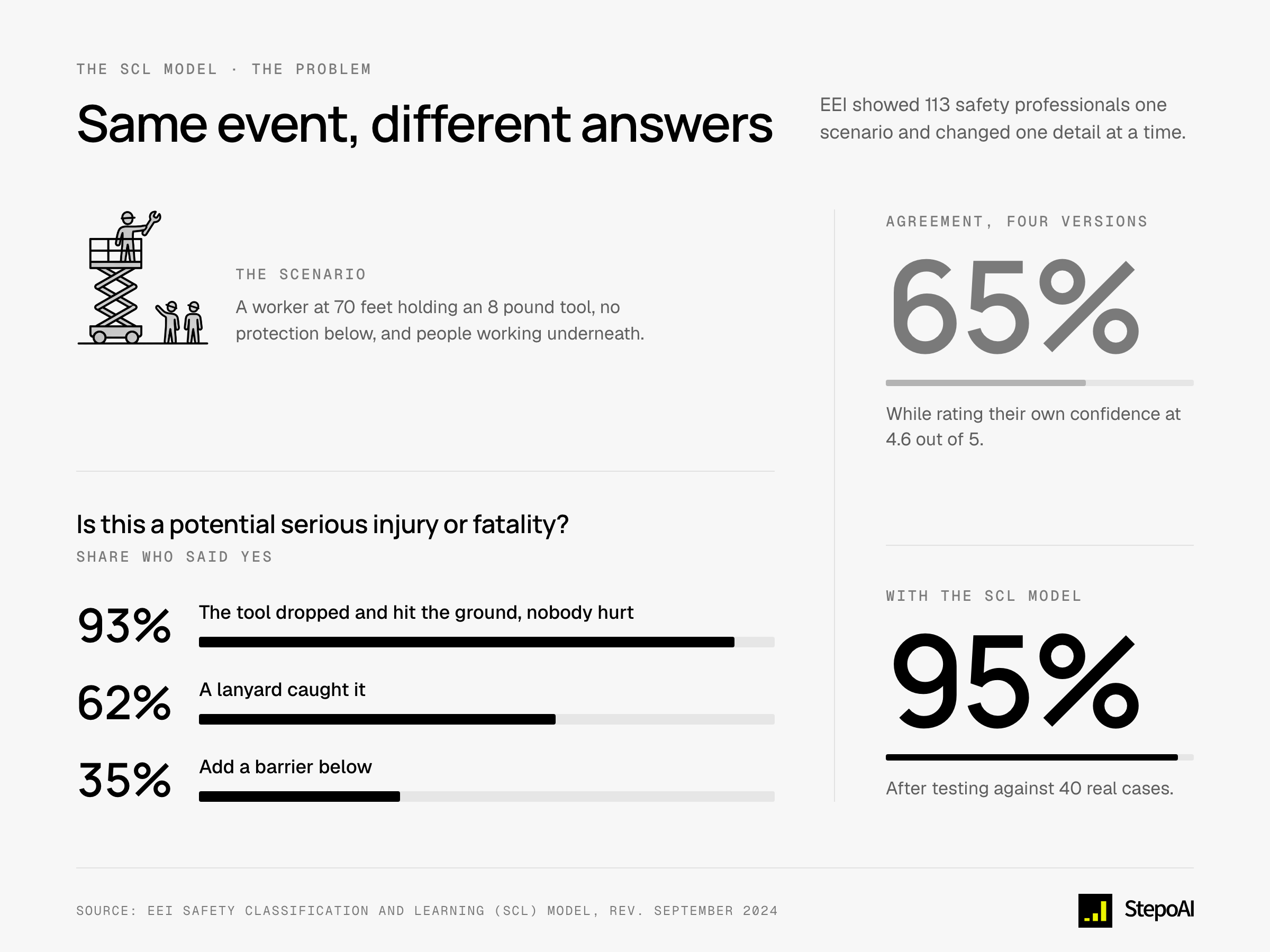
EEI once showed 113 safety professionals the same scenario: a worker at 70 feet holding an 8 pound tool, no protection below, and people working underneath. They changed one detail at a time and asked one question. Is this a potential serious injury or fatality? When the tool dropped and hit the ground with nobody hurt, 93 percent said yes. When a lanyard caught it, 62 percent. Add a barrier below and it fell to 35 percent. Across the four versions the group agreed only 65 percent of the time, and they rated their own confidence at 4.6 out of 5.
That is the problem the Safety Classification and Learning model was built to solve. When two safety managers look at the same near miss and file it differently, nobody can trend it, share it or learn from it. The SCL model, written for the Edison Electric Institute by Dr. Matthew Hallowell with a working group of 20 utility safety leaders, replaces the judgment call with four questions. After testing against 40 real cases, the group's agreement went from 65 percent to 95 percent.
Four questions, every time
The model asks the same four questions about any observation, near miss or injury, in order. Was high energy present? Was that energy released with someone touching it or close to it? Was anyone seriously hurt? Was a direct control in place? The answers put the event in one of seven buckets, and the bucket tells you how much learning to invest.
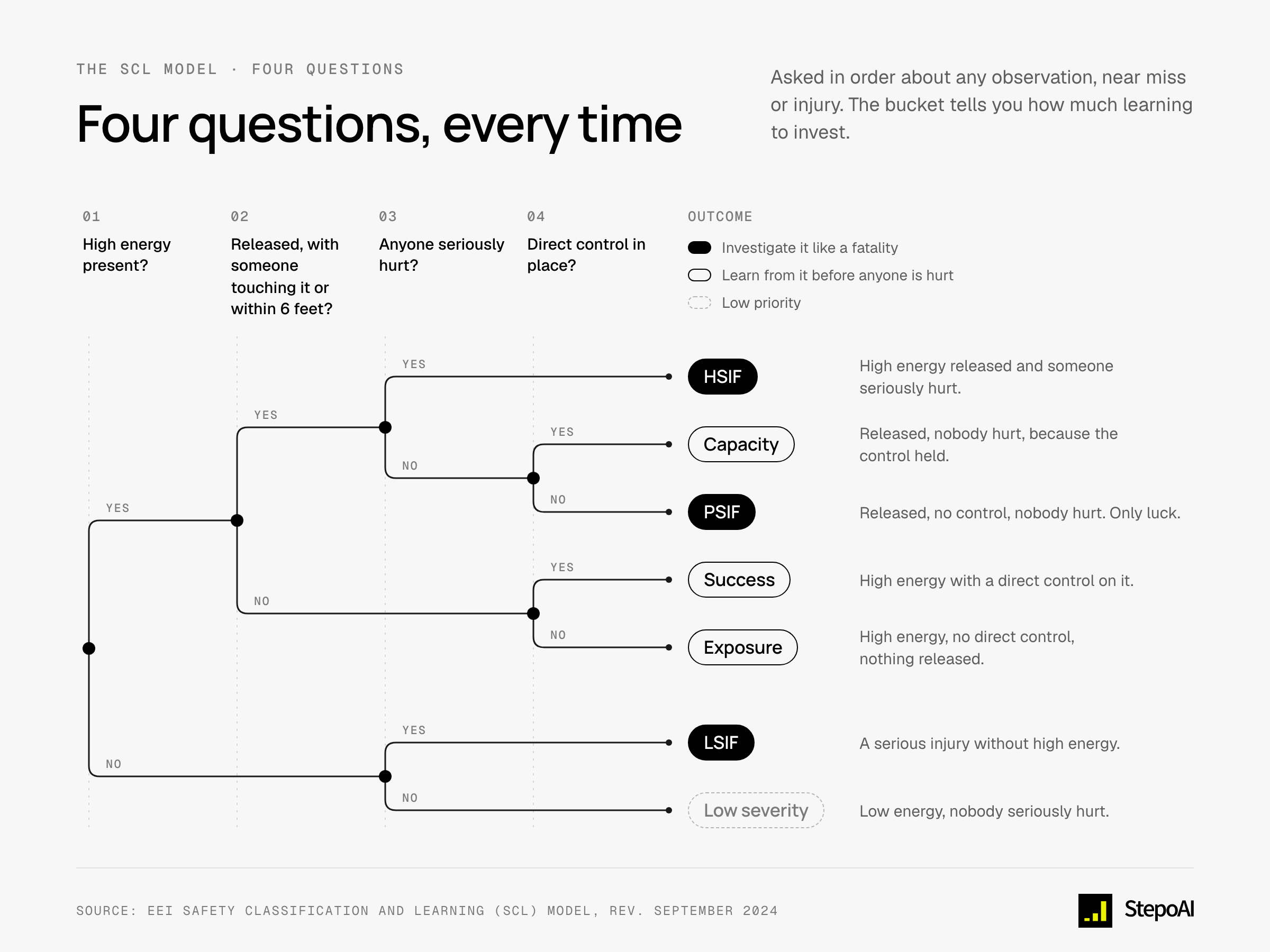
The order matters. No high energy, and the rest carries little weight, because low energy events almost never kill anyone. High energy that was never released is a condition, not an incident, and you get to learn from it before anyone is hurt.
What counts as high energy
High energy means more than 500 foot pounds, the point where a study of more than 500 injuries found a serious injury or fatality becomes the likely outcome rather than a remote one. Nobody in the field is doing that math, so EEI translated it into 13 hazards that are almost always over the line: a suspended load, a fall of 4 feet or more, mobile equipment or traffic near workers on foot, a vehicle at 30 mph or more, heavy rotating equipment, anything 150°F or hotter, steam, fire with a fuel source, an explosion, a trench 5 feet or deeper, electrical contact at 50 volts or more, arc flash, and a high dose of a toxic chemical or radiation.
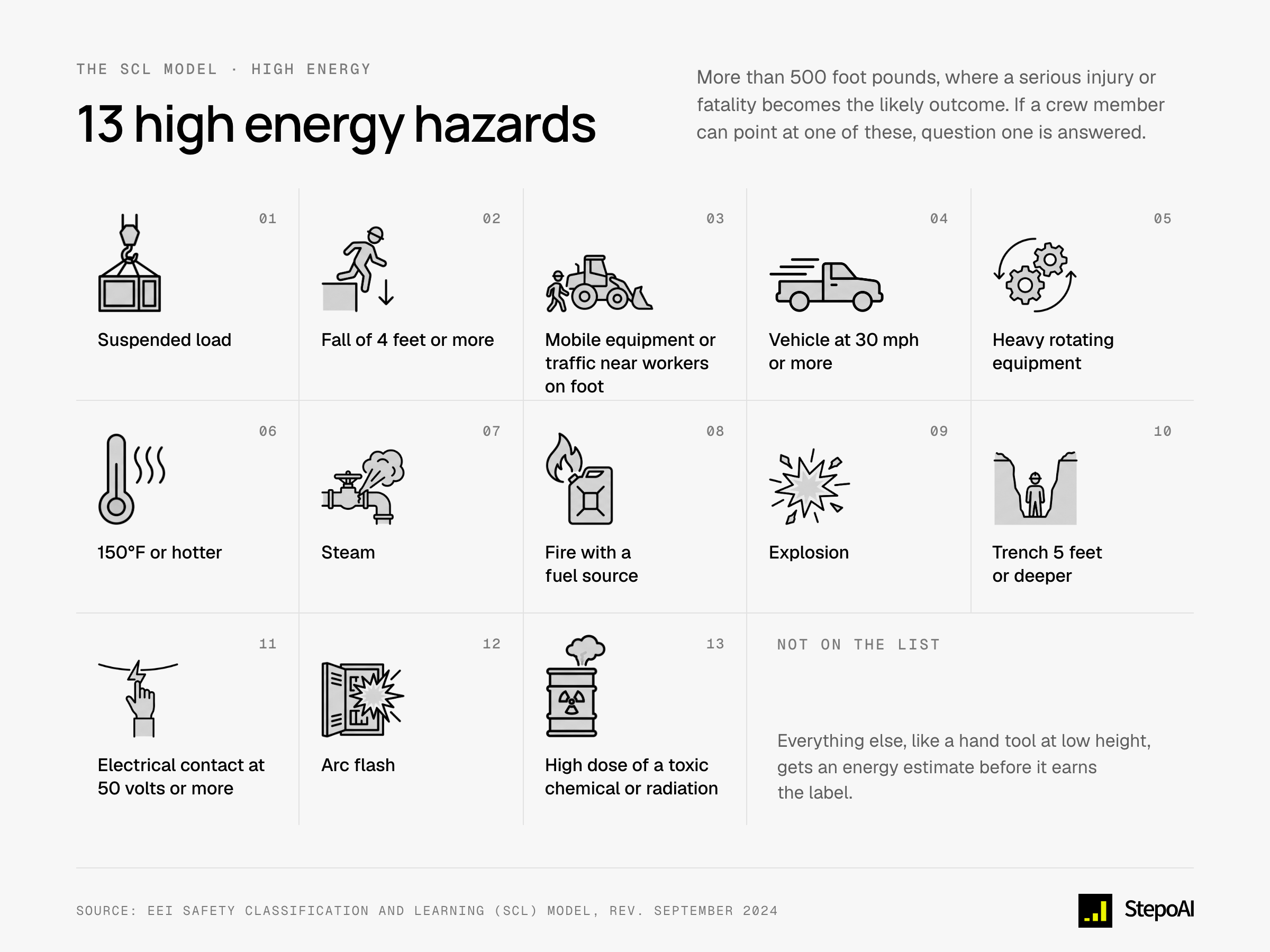
If a crew member can point at one of those, question one is answered. Everything else, like a hand tool at low height or a scratch inside a confined space, gets an energy estimate before it earns the label.
What counts as a direct control
This is where most of the arguments happen, so the model draws a hard line. A direct control has to pass three tests. It is aimed at that specific energy source. It stops or reduces the exposure when it is installed, verified and used right. And it still works when a worker makes an honest mistake. Lockout, machine guarding, hard barriers, fall arrest and rubber cover up pass. Training, warning signs, rules, experience and standard PPE do not, because one lapse defeats them. Specialized gear like rated rubber gloves or an arc flash suit does count, because it is built for that energy.
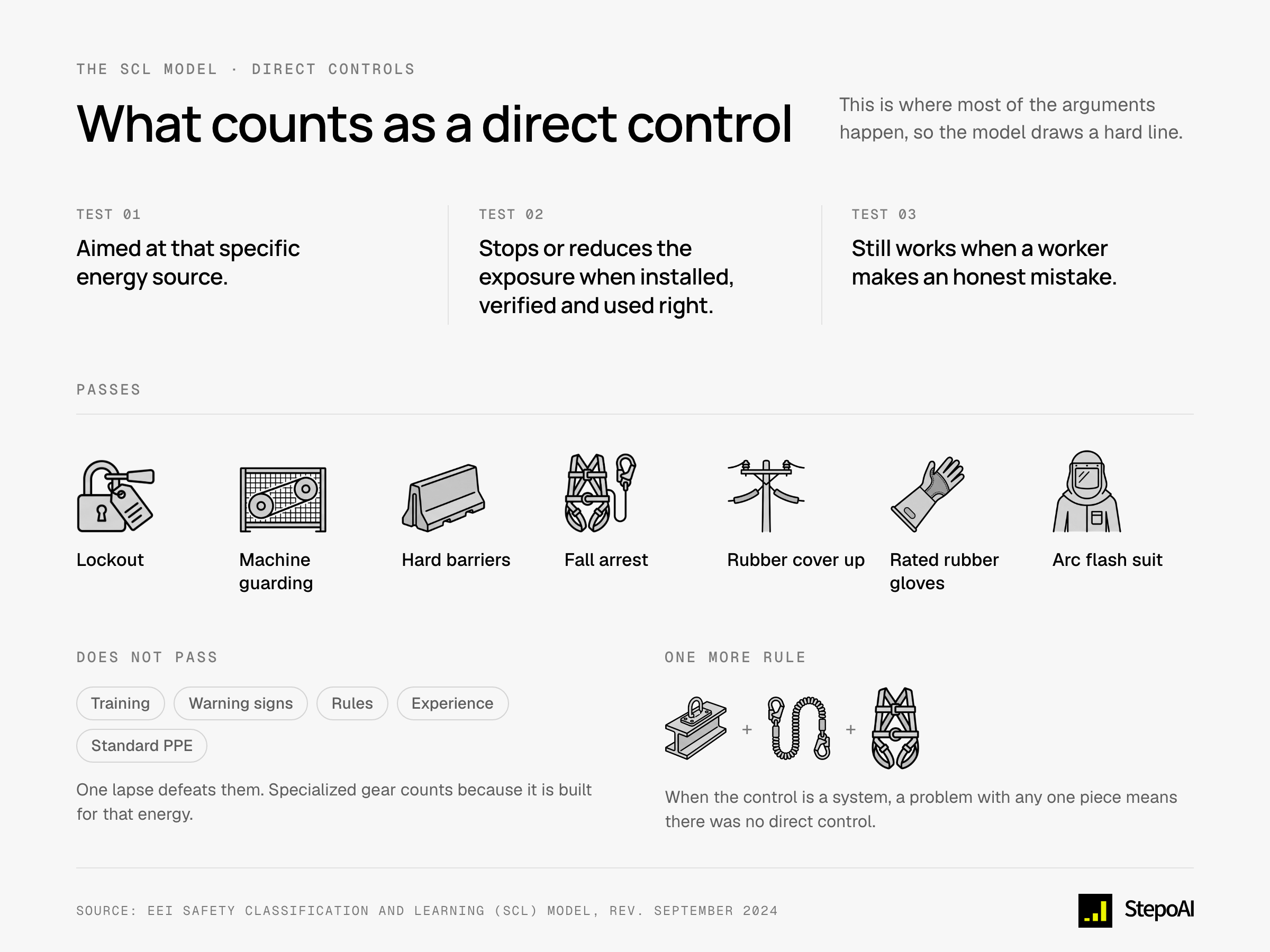
One more rule catches people. When the control is a system, like an anchor, a lanyard and a harness, a problem with any one piece means there was no direct control.
Seven outcomes from one lineworker
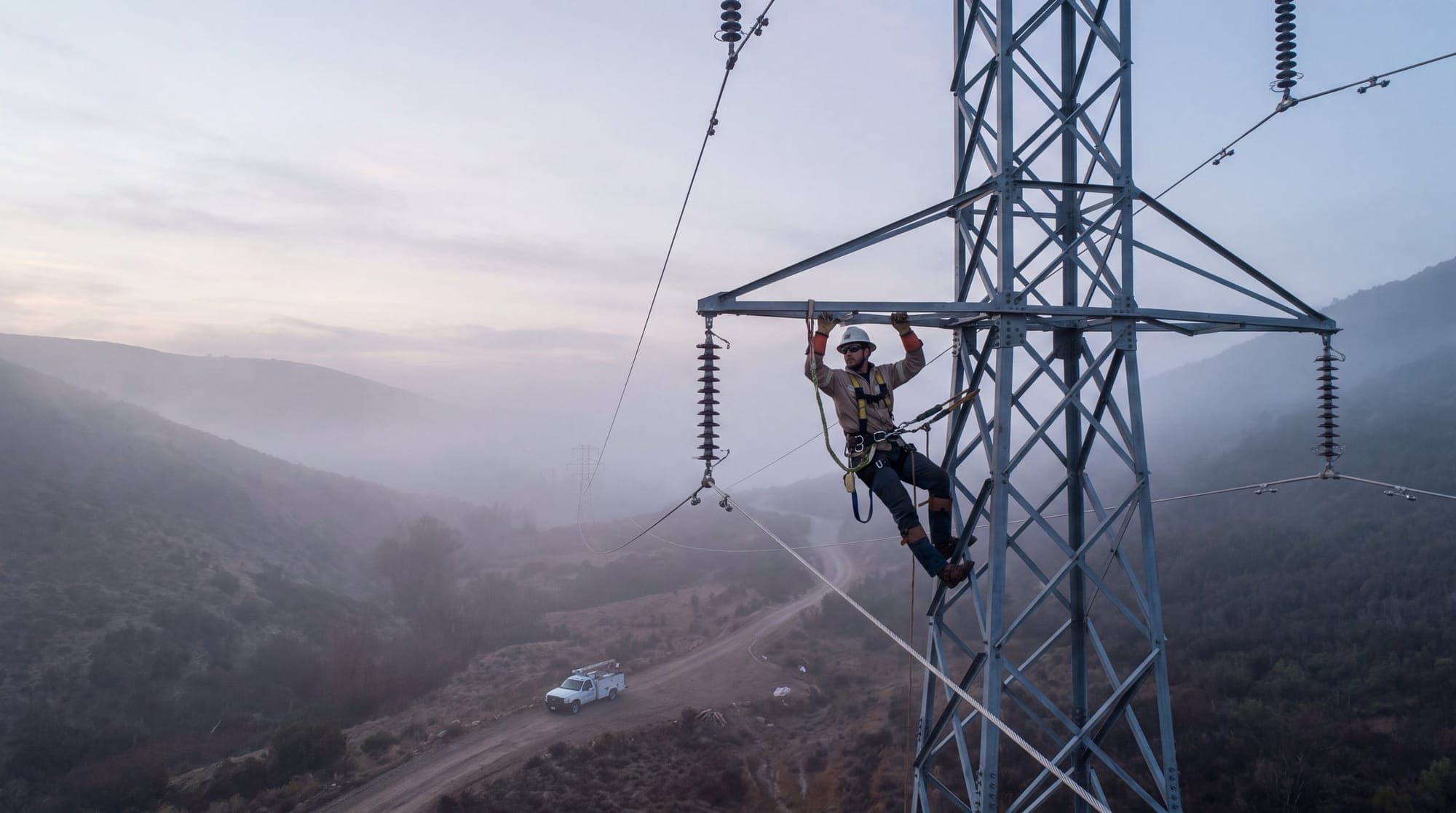
EEI's own example makes the buckets click. Picture a transmission lineworker at 100 feet.
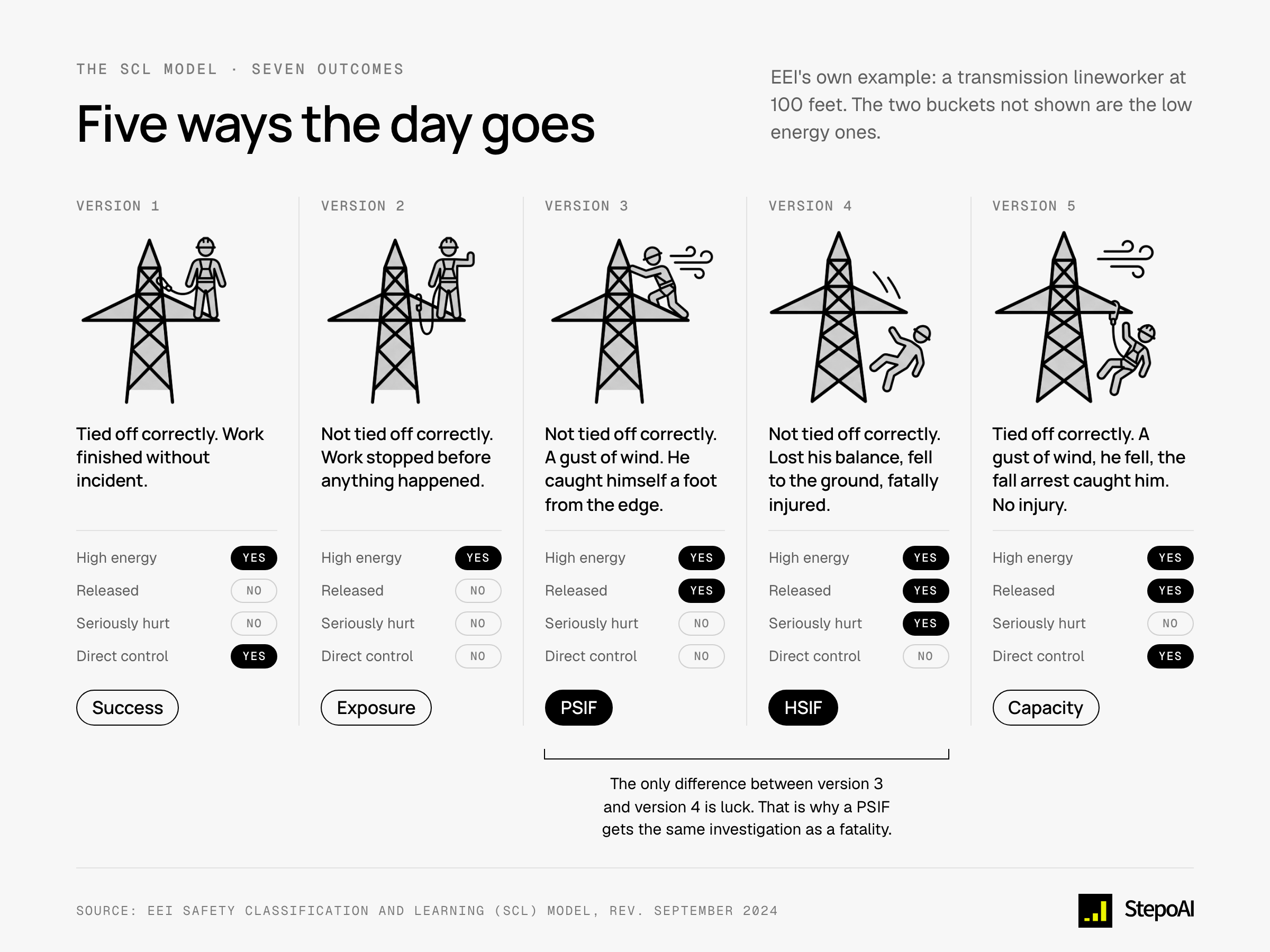
Tied off correctly, work finished without incident: Success. Not tied off correctly, work stopped before anything happened: Exposure. Not tied off, a gust of wind, caught himself a foot from the edge: PSIF. Not tied off, fell, fatally injured: HSIF. Tied off correctly, a gust of wind, fell, caught by the fall arrest, no injury: Capacity. The two buckets not in the picture are the low energy ones: a serious injury without high energy, like a broken ankle from rolling it on a cord, and everything else.
Notice what a near miss form never does. It defines success, a high energy hazard with a direct control on it, and capacity, a control that got tested and held. Both are worth recording. The only difference between the PSIF and the HSIF is luck, which is why EEI says a PSIF deserves the same investigation as a fatality.
Learning, not a scoreboard
EEI is blunt about how not to use this. Do not turn PSIF into a rate. A high PSIF count can mean poor control use or a crew that reports everything, and a low count can mean strong performance or people keeping quiet. The moment a PSIF number lands on a bonus sheet, the reporting dries up and the learning goes with it. The measure the report does suggest is the share of your high energy observations that come back as Success. That number only moves one way, and it moves before anyone gets hurt.
How this shows up in StepoAI
Field data comes in messy. A team leader says what they saw into a phone, takes a photo and moves on. StepoAI structures that entry with the same fields on every site: energy source, SIF potential, the controls that were in place and whether they were effective, the corrective action and its owner. That is the four questions running on every observation, not only the ones that reach an investigation. On the Visibility dashboard a director sees open SIF, open PSIF and major risk with basic or no controls ranked by project, so where to look first is already answered. What the field learned goes back out as a toolbox talk for the next crew.
The point
Same words, same classification, every site. That is what makes a thousand observations worth more than one investigation.
Sources: EEI Safety Classification and Learning (SCL) Model, revised September 2024 and Hallowell and Spencer, Professional Safety, February 2024.
Keep reading
Related Posts
Continue reading with these related articles